|
|
|
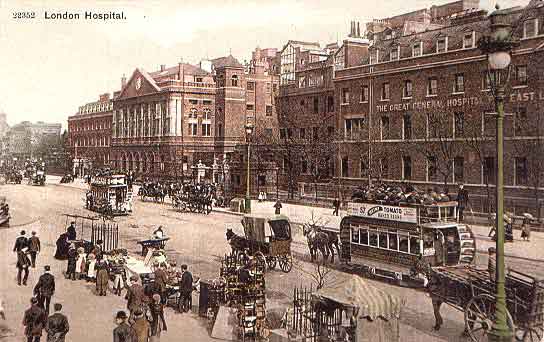
London Hospital, Whitechapel Road |
|
The London
Hospital started as the London Infirmary in 1740 by John Harrison and
six friends in Prescott Street. Its
primary aim was to serve the people of the East End.
In 1741, it was clear that a new larger premises were needed.
A plot of land in Whitechapel Road was purchased.
Concerns were raised to the sighting of the new hospital that would
be in opened fields and some way
from the City of London ! However,
the Hospital was built and given a new name the London Hospital .
Patients were being treated there in 1757. In 1758 the London
Hospital was granted a Royal Charter and throughout its history it has
had close connection with the Royal Family.
The Queen is its Patron and in 1990 she gave permission to the
Hospital to add Royal to its title, becoming the Royal London
Hospital . The London
Hospital has been in the forefront of medical developments, new ways of
caring for patients and the introduction of new treatments.
Amongst the pioneering developments were: a medical school in 1795,
Children s Ward 1840, Training of Nurses in 1888, and the introduction of
a ward with special kitchen for Jewish patients.
It is still in the forefront of medical developments and in 1990 a
helicopter service was introduced flying from the roof of the west wing. From its beginnings, The London , as it is know locally, has been at the
centre of the East End Community. During
the Great Cholera Epidemics in the East End during the mid 1850s, the
Hospital had 865 in-patients and 13,00 out-patients.
In 1886, John Merrick, the so called Elephant Man , was on
display in a peep show directly opposite the Hospital. He was rescued from
the peep show by Sir Frederick Treves, who
found him a home in the Hospital and where he later died.
Edith Cavell trained as a nurse there. During the First World War, it treated wounded service men and in the Second World War became a major Casualty Hospital, when most of its usual services transferred to other hospitals. Being in the front line during the Blitz, the Hospital not only treated the victims of the bombing but was badly damaged as well. Then in August 1944 a doodlebug, or flying bomb, demolished the East Wing killing two patients. The London Hospital is still a major casualty hospital, having dealt with the injured in both the 1975 Moorgate Tube disaster and the Aldgate Tube bombing in 2005. Up and till the Second World War, the London
Hospital was the largest voluntary hospital in the country with nearly
1000 beds. In 1948, the
Hospital became part of the National Heath Service and in 1967 was joined by
Mile End and St Clements (Bow). Then
in 1995, the Royal London merged with Barts and the London Chest Hospitals
to form The Royal Hospital NHS Trust.
In 2012 a brand new, state-of-the-art, Royal London Hospital building was opened nearby and the old building closed as a hospital. The historic Grade II listed building was redeveloped in 2023 to become the new Town Hall for Tower Hamlets Council, preserving its facade and historical significance.
|