|
|
|
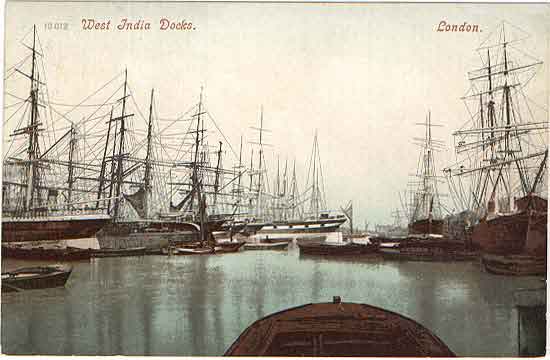
West India Docks, Poplar |
|
Through an Act of Parliament, The West India Dock Company was given
permission to construct at dock system at Poplar. The foundation stone was
laid in 1800 and opened to shipping in 1803.
The magnificent dock system was made up of an Import Dock, 500 feet wide, and an Export Dock, opened in 1806, 400 feet wide. Both were nearly a mile long and 31 feet deep. Constructed on the north quay of the Import Dock were nine Georgian warehouses, mostly five storeys high. These were built to hold a years crop of sugar and molasses from the West Indies. On the south quay were vaults built to store West Indian Rum. To help pay for the construction of the West India Docks, the Company were given a twenty-one years monopoly on all cargoes shipped to London from the West Indies. Similar rules applied to exports to the West Indies. Vessels using the dock had the right to remain there for six months. In 1806, the Corporation of London open the City Canal, built south of the West India Docks. The City Canal cut the Isle of Dogs in two and allows shipping to reach the Pool of London without going via Greenwich. The City Canal was not popular with shipping companies as they would not pay to use it. So in 1829, the City of London Corporation sold the unprofitable City Canal to the West India Company, who named it South West India Dock and later South Dock. Through a series of mergers in the nineteenth century, caused by the lack of profits made by the London Dock Companies, eventually lead to the Government privatising the whole of the London Dock system in 1909. To manage the London Dock System and the Tidal River Thames, the Government created the Port of London Authority. The Docks were principle targets for the German bombers in the Second World War. The West India Docks were extensively damaged. Three-quarters of the magnificent north quay Georgian warehouses were destroyed. In 1980 the West India Docks closed and later became part of The Dockland Development Corporation (LDDC). They gave permission for Canary Wharf to be built between the Import Dock and the South Dock. Part of the north quay Georgian warehouses have became the Museum in Docklands. This fantastic Museum traces the history of the River Thames, the London Dock System and the people who lived and worked in and around the Great Port. |