|
|
|
St Peter’s London Docks, Wapping |
|
The
foundation stone was laid in 1865 and was consecrated the following year by
the Bishop of London. However
the origins of the Church were
laid in 1856 when an Iron Chapel was built nearby in Calvert Street. This Chapel formed part of the St George’s Mission which
also had a Chapel in Wellclose Square.
The Iron Chapel could hold 200 people and became so popular that
plans were soon drawn up to build a permanent church and a new parish in Old
Gravel Lane, now Wapping Lane. Fr
Lowder, the first priest, through friends and donations from local people,
managed to raise sufficient funds for the construction to begin..
However, by the time the main parts of the Church
were complete, funds had run out and the proposed tower and the west
wing were put aside for construction later.
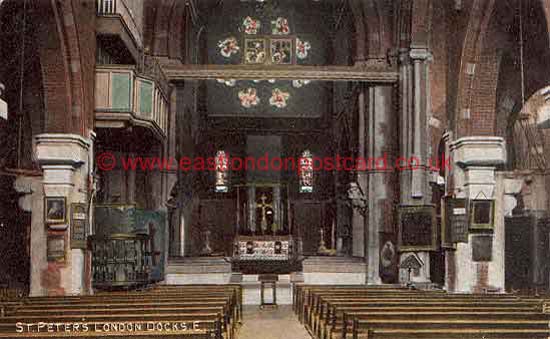
St Peter’s Church was built in the fashionable Gothic style with
polychromatic brickwork. The
Church has a warm looking interior. In
1881 it was decided to complete
the west end of the Church and
erect a baptistery and mortuary Chapel.
Also a Clergy House was built on side one side of the Church entrance
and a Sister’s House on the other. This
created a large arch through which the Church
is reached. Fr
Lowder will always be associated with St
Peter’s Church. He
experienced difficult times in the beginning.
But this antagonism was soon to change when during the cholera
epidemic of the 1870s, Fr Lowder refused to leave Wapping and worked
tirelessly to help the poor and the sick.
This won the hearts of Wapping people and from then on he became
known as just “Father”. After
50 years work he died in Switzerland, where he had gone to recuperate from a
long illness. Funds were raised
by his parishioners to bring his body home.
After a Service in a crowded St
Peter’s Church, he was taken through the packed streets of Wapping to
Chislehurst in Kent. In 1884, Fr Lincoln Wainright, who had been a curate with Fr Lowder, began his work at St Peter’s Church. He also worked tirelessly without a break for 45 years, providing schools, clubs and medicine and nursing facilities for his parishioners. He also served on the Stepney Borough Council and was a member of the St George’s Board of Guardians. He died in 1929. After his funeral service in St Peter’s Church, he was buried in the St Peter’s plot at the East London Cemetery, Plaistow. During the Blitz, Wapping, being close to the London Docks, became a prime target for the Luftwaffe. On 15th October 1940, a bomb fell on the Sister’s House killing one of the Sisters, Sister Elizabeth. The clergy house was damaged and the interior of the Church wrecked, the blast destroying most of the stain glass windows. St John of Wapping was totally destroyed and not rebuilt. However, St Peter’s was repaired. In 1951 it was decided to combine the two parishes. Later St Peter’s received a new name, “St Peter’s Church, London Docks with St John of Wapping”. |